

Within the business of healthcare, there are routinely conflicts based on competing self-interests—conflicts among physicians, conflicts among physicians and staff, and conflicts among physicians or staff and patients.
Relatedly, conflict is inevitable when it comes to healthcare compliance. Any time you challenge a deeply-rooted process, identify risk in a shortcut preferred by operations, or insist on a control that slows a workflow down—tensions are going to rise.
Keep in mind that disagreements don’t make you ineffective, they are a natural human response. How you handle them though—that’s going to define your effectiveness. For that reason, repairing relationships after a conflict is a highly valuable skill in a compliance officer’s toolkit.
So what are some strategies for repairing a relationship after a conflict?
That will be the focus of this article.
Take the First Step—And Do It with Intention
Even if you weren’t the cause of the tension, be the first to reach out.
Now to be clear, I’m not suggesting you apologize for enforcing a compliance initiative; rather, be the first one to take a step towards communicating with the other party. Here, you want to maintain your focus on resolving the issue for the benefit of both parties vs. making the discussion about the other person in order to achieve some type of personal gain.
When it comes to taking that first step, here are some tips that may help:
Suggest a follow-up meeting framed as, “I want to make sure we’re aligned moving forward.”
Avoid email for sensitive repairs. Instead use a method that fosters dialogue (e.g., face-to-face, video call, phone call).
Keep your tone calm and mind focused on being curious and not judgmental.
Taking this first step is a way to acknowledge the human side of a disagreement, which will help you maintain your credibility. This approach also signals maturity, steadiness, and leadership presence—qualities that help you build trust over time.
Separate the Person from the Problem
Another strategy, (alluded to above), is to keep your mind focused on the issue and not the other person. Conflicts related to compliance matters often stem from differing priorities. For example, operations wants speed and efficiency while compliance wants time to analyze and mitigate risk.
In the past I’ve written about the fact that any healthcare organization has two agendas: the business agenda and the compliance agenda. Often times those agendas don’t align and that’s where personal interests collide. The real challenge then becomes finding a solution that is compliant—and business friendly.
In order to keep your focus on the issue and not the other person, consider the following tips:
Take the time needed to fully understand the other person’s point-of-view (positions and interests), with a curious mindset—not a judgmental one.
Ask yourself “What is the most generous interpretation” of what this person has said?”
Use collaborative language like: “I understand you want this workflow to move smoothly. Let’s see how we can do that while remaining compliant.”
When the conversation stays focused on the issue instead of the individual, collaboration between the business and compliance agendas becomes easier and more productive.
Validate Their Perspective—Even If You Don’t Agree With It
One of the most common mistakes newer compliance officers make after a disagreement is trying to convince operational leaders that compliance was “right.” Though it may be well-intentioned, convincing often backfires.
For example, assume a compliance officer identifies a Stark risk tied to a physician compensation arrangement. More specifically, let’s imagine the description of duties in the agreement doesn’t match the services being performed by the physician. Operations is frustrated because the “new” duties have been in place for years and supports service line growth. Let’s further assume that when confronted with these facts, the compliance officer leads with:
“I understand this is inconvenient, but the law is very clear. If we don’t fix this, the organization could face serious penalties. Compliance has to come first”
Even if this statement is technically accurate, the message implicitly says to the leader:
Your pressures don’t matter;
Your frustration is irrational; and
This conversation is over.
(Not good.)
Even if the leader complies—trust has been eroded and any future issues will feel adversarial to that leader.
(On second thought, make it a double on that “Not good”.)
Validation doesn’t mean agreeing that the risk should be ignored; rather, it means placing value in the logic and pressure behind the leader’s position. Healthcare leaders operate under intense pressure: financial margins, physician satisfaction, patient access, and regulatory oversight—all of which simultaneously compete for their attention.
When a compliance officer skips validation and moves straight to persuasion, leaders will experience compliance as disconnected from reality.
Recalling back to the above scenario, a better starting point might be saying something like:
“I can see why this feels frustrating. This arrangement supports service line growth, and any changes impact real business goals. Anyone in your role would be concerned about that. What if we engaged in the following strategy to address this issue so you can move forward again...”
Did you notice what happened with that small shift?
First, the leader feels seen, and not corrected. Secondly, their priorities are acknowledged as legitimate. Finally, the emotional temperature of the conversation drops—almost instantly.
If validation is an area you struggle with, here are a few tips that may help:
Keep your focus on validating the pressure—not the compliance risk.
Name what you’re hearing (e.g. “What I’m hearing you say is timing and resources are your biggest concern.”)
Acknowledge impact and not intent (e.g., “I can see how this change disrupts your workflow.”)
When it comes to a compliance conflict, validation reconnects people because it signals respect for operational expertise, reduces the instinct to defend, and creates psychological safety for honest dialogue.
Keep in mind that anytime you try to convince someone (who doesn’t want convincing), you disconnect. To the contrary, anytime you validate, you connect. In my experience, when leaders feel heard, they’re more open to hearing you.
Reset the Relationship with a Forward-Focused Plan
After a conflict, many compliance officers breathe a quiet sigh of relief once the immediate issue is resolved. But without an intentional reset, the relationship can remain strained. As I alluded to above, while leaders may comply in the moment, they may carry lingering frustration that surfaces later as resistance, avoidance, or reluctance to engage compliance early.
To ensure that trust is restored and the relationship does not feel adversarial to the leader, focus on clarifying how you will work together next time—and not rehashing who was right or wrong.
To help you reset a relationship, consider asking questions such as:
“What would help our communication feel smoother next time?”
“How can I better support your team while still protecting the organization?”
“Is there anything we can agree on related to how we handle similar issues in the future?”
If you take a look at those questions, you should notice a theme—Agreement. Keep in mind that agreements, whether they are formal or informal, give both sides psychological safety. And psychological safety is what you want if you want to effectively repair a relationship.
_______________
**Note: Resetting relationships is exactly the type of unwritten rule that I help coach compliance officers with inside my course. If the “people part” of the job is an area holding you back, join us inside the course today. **
_______________
Why Repair Matters: Navigating the Politics of Healthcare
Healthcare, like any industry, can be intensely political—not in the partisan sense, but in the human sense. Healthcare leaders remember who supports them, who challenges them respectfully, and who treats them with dignity when tensions rise.
When you repair relationships well:
You build allies for your compliance program in places where you once had conflict;
You reduce resistance for future initiatives; and
You develop a reputation as steady, strategic, and trustworthy.
While things like regulations, policies, and codes of conduct serve as the face of compliance, where compliance comes to life is in the people. Relatedly, as your influence grows, it directly impacts the effectiveness of your compliance program. And in the political landscape of healthcare, the compliance officers who rise are the ones who know how to recover, reconnect, and rebuild—even after conflict.
Pulling it All Together
Disagreements are unavoidable in an environment where risk, revenue, and patient care intersect. What sets effective compliance officers apart is their ability to restore trust after tension so that the organization can continue to move forward.
Repairing relationships isn’t about smoothing things over. It’s about strengthening your professional resilience and reinforcing your role as a business partner in the organization. When you approach conflict repair through the above-noted strategies, you’re doing so with intention. Over time, these moments demonstrate leadership beyond your title and help shape how leaders perceive compliance—not as a barrier, but as a steady, thoughtful business partner.
For compliance officers navigating the corporate politics of healthcare, knowing how to repair a relationship is the difference between being tolerated—and being trusted.
Feeling isolated from your healthcare leaders?
Are you struggling to get them to care about compliance?
It's not about how much you know.
It's about how you communicate what you know.
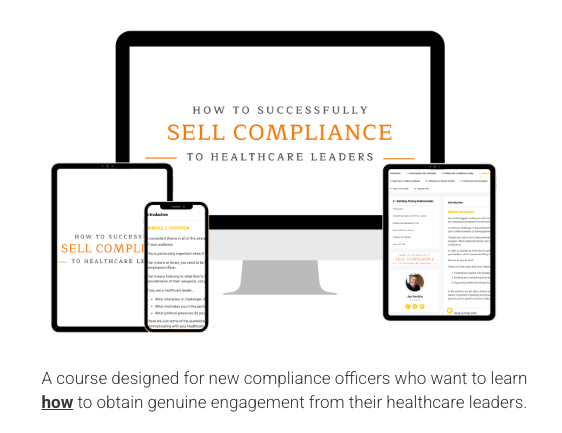
That’s exactly why I created How to Successfully Sell Compliance to Healthcare Leaders.
𝐘𝐨𝐮𝐫 𝐫𝐞𝐠𝐢𝐬𝐭𝐫𝐚𝐭𝐢𝐨𝐧 𝐢𝐧𝐜𝐥𝐮𝐝𝐞𝐬:
Lifetime access my communication and relationship-building playbook.
Personalized coaching with me.
Access to a private peer community with bonus live trainings.
Self-study CEU credits available.
